

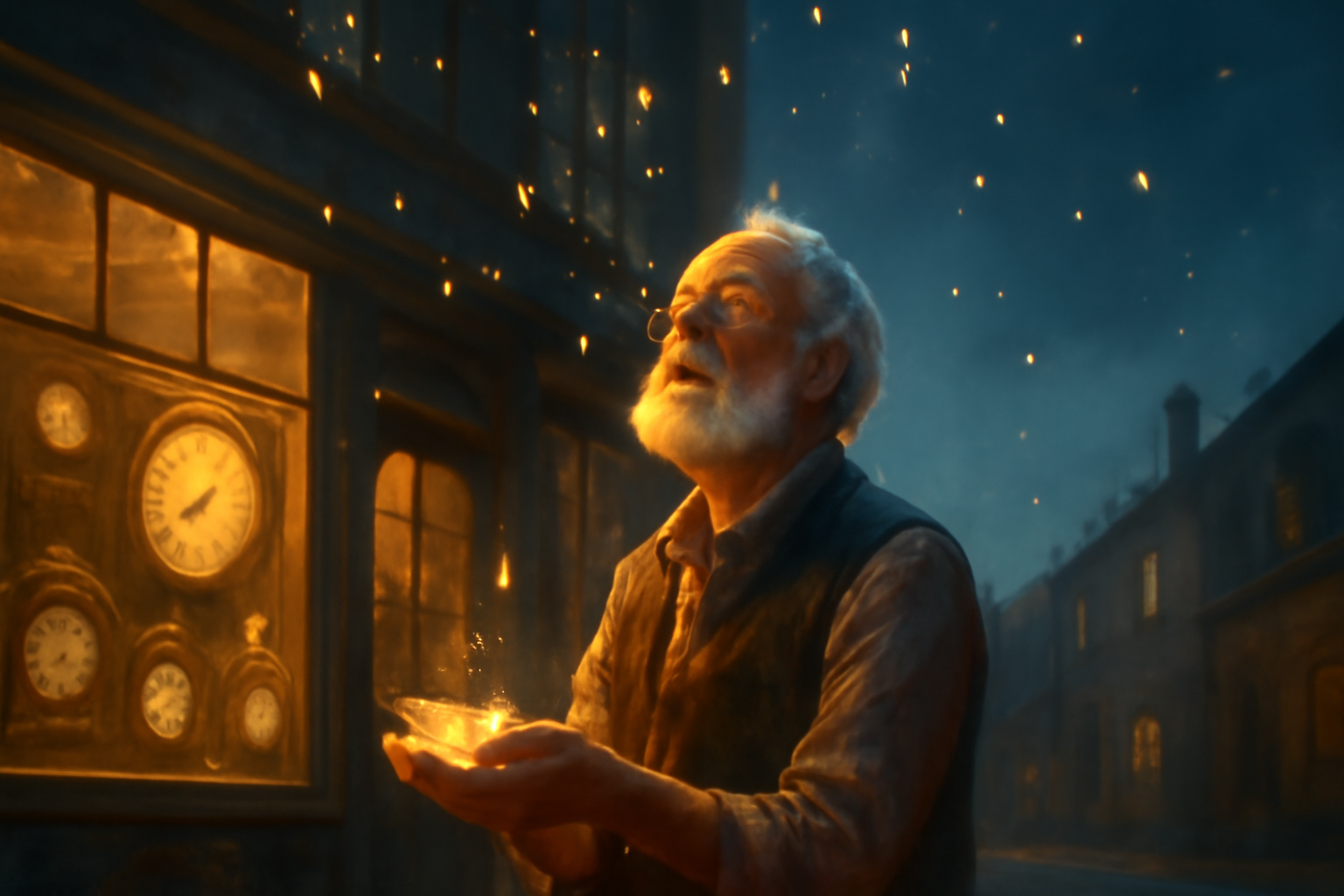
The first minute fell while Elias Finch was polishing a pocket watch.
He didn’t see it at first.
He heard it.
A soft tink on the counter beside him, too light to be a dropped screw, too bright to be a stray grain of metal. He glanced up, expecting to find one of the tiny brass springs he was forever losing.
Instead, he found a sliver of light.
It lay there, no bigger than his thumbnail, shimmering faintly like a captured droplet of sunrise. It wasn’t solid, exactly, but it wasn’t not-solid either — more like the idea of a thing made briefly visible.
Elias frowned behind his spectacles.
“You don’t belong here,” he murmured.
The minute did what any self-respecting minute would do when noticed.
It trembled.
Then tried to roll away.
Elias, who had been a clockmaker for forty years and knew better than to panic when time misbehaved, cupped his hand gently over it.
“Easy now,” he said, as if soothing a spooked bird. “Let’s not go slipping under the cabinet, hmm? I’ll never get you out of there.”
The minute pulsed against his skin.
Warm.
Alive.
Ridiculous, he thought, that time should feel warm.
Even more ridiculous that it had just… fallen. From where? The ceiling? The sky? Some unseen crack in the ticking fabric of the afternoon?
Outside, the town of Willowstead went on as usual. The bakery bell chimed next door. A bicycle bell rang twice as someone zipped past. The old church clock across the square struck three with mild surprise, as though three had arrived sooner than expected.
Elias lifted his hand.
The minute lay perfectly still in his palm, glowing faintly.
“You’re not a screw,” he said. “You’re not a spring. And I am, regrettably, too old to assume I’m hallucinating. So…”
He glanced up at the narrow window above his workbench.
Outside, the sky shimmered.
And another minute fell through.
They came slowly at first.
Little shining slivers that slipped through the glass without disturbing it, as if walls were suggestions rather than rules. They drifted down like new snowflakes, each landing with a tiny musical chime on wood, on metal, on the soft wool of Elias’s sweater.
He stood very still, hands half-raised, heart beating faster than it had in years.
“Well,” he said finally to the empty shop. “This is… new.”
The minutes gathered on his workbench, on the shelves, in the air. Some hovered lazily, content to float. Others rolled in quiet circles, bumping gently into one another.
Elias eyed the old regulator clock on the wall.
Its pendulum swung steadily.
Its hands moved calmly.
But the space around it seemed thicker, wider, like the air had become a river with something heavy dumped upstream.
He cleared his throat.
“I don’t suppose,” he said carefully, addressing the shimmering motes, “you’re here to make a mess of things?”
One of the minutes bobbed toward him and brushed his knuckle.
He saw something.
Not a picture; more like a feeling compressed into image.
A woman sitting on a bus stop bench, eyes closed, head tipped back to catch a sliver of sun. Her coffee cooling beside her. For exactly one minute, she forgot her emails, her deadlines, her aching feet.
It was a small, bright happiness.
Then it was gone.
Elias blinked.
The minute drifted back into the air.
“Oh,” he whispered. “You’re… the lost ones.”
He looked around at the growing cluster.
“The wasted minutes. The ones people dropped when they were too busy being late, or worried, or tired to notice them. The ones that came and went and never quite belonged to anyone.”
The minutes quivered, as if pleased to be named.
Elias Finch had spent four decades repairing time.
Clocks that ran too fast.
Watches that slowed to a crawl.
Old mantelpieces that refused to strike on the hour.
He’d always seen time as a thing to be shepherded, tamed, kept in order.
Now it was showing up at his door in little glowing fragments, asking — in the only language it had — to be taken care of.
He sighed, affectionately exasperated.
“Of course,” he said. “Of course the universe decides that an old clockmaker with a bad knee and one good eye is the person to deal with… this.”
Another minute landed in his tea.
It fizzed, turning the liquid a shade brighter.
Elias stared at his cup.
“Right,” he said. “First things first, then. We’ll need somewhere safe to keep you.”
He set down his polishing cloth, opened the drawer where he’d once kept particularly beautiful watch faces, and gently tipped a few of the minutes inside.
They settled like fireflies in a jar.
The room hummed faintly.
Elias’s heart lifted in his chest, in a way it hadn’t since Esther died.
By the end of the week, he had three drawers full.
They fell every day at odd hours — never so many that he couldn’t keep up, never so few that he could pretend it had been his imagination.
He began to notice something else, too.
The more minutes collected in his shop, the more the world outside slowed.
Not in a frightening way. In a kind way.
Customers who used to rush in, flustered and apologizing for being late, now paused in his doorway as if stepping into a different kind of day. They lingered over the tick of the tall grandfather clock in the corner. They sat on the little wooden chair by the counter and told him stories.
“I was in such a hurry this morning,” Mrs. Kemp from the post office said one Tuesday, smoothing her skirt. “Then I saw a bird carrying a twig that was far too big for it, and I stood there laughing for a whole minute. It felt… extravagant.”
“Perhaps the day owed you a minute,” Elias suggested.
She smiled thoughtfully.
An exhausted student came in to collect the wristwatch he’d repaired and ended up napping in the chair for ten minutes while Elias pretended not to notice.
The town, it seemed, was leaking time.
And it was all rolling downhill into his shop.
Elias didn’t entirely mind.
He wasn’t lonely, exactly. The memories filled the quiet spaces. The smell of oil and metal and wood kept him company. But since Esther’s passing, the evenings had stretched a bit too wide.
Now, the falling minutes kept him busy.
He sorted them instinctively.
Buzzing anxious ones in the top drawer.
Soft, sleepy ones in the middle.
Bright, bubbly ones that smelled faintly of citrus in the bottom, where they wouldn’t keep the others up.
Occasionally, he’d touch one and get a flash of something.
A skipped stone.
A shared joke between strangers.
A sigh of relief after finishing a long task.
He began to recognize patterns.
“Not wasted,” he murmured one evening, watching a silver-blue minute drift lazily toward the ceiling. “Just forgotten.”
The old clock on the wall ticked approvingly.
One afternoon, just as the church bells were considering whether to ring two, the shop door chimed.
Elias looked up from the drawer of minutes.
A little girl stood there.
She had a backpack almost as big as she was, scuffed shoes, and a face that looked like it had forgotten how to smile but remembered it used to, once.
“Hello,” Elias said gently. “Can I help you?”
“You fix time,” she said matter-of-factly, pointing at the clocks.
“I mend what I can,” he agreed.
She stepped closer to the counter, eyes scanning the shelves as if she were looking for something specific.
“I lost some,” she said.
He tilted his head.
“Some what?”
“Some minutes,” she said. “Maybe more. Nana says I keep losing time staring out the window. But I don’t know where it goes. I thought maybe you’d have it.”
Elias’s heart did a small, startled twist.
He looked down at his drawers.
At the glowing fragments of bus-stop sun and bird-flight and laughter.
“Maybe I do,” he said softly. “What’s your name?”
“Amelia.”
“Well, Amelia, what do your lost minutes look like?”
She scrunched her nose, considering.
“They’re the ones that feel nice and fizzy here,” she said, pressing a small hand to her chest. “When I’m thinking stories. But then people say I’m not paying attention and they go away.”
Fizzy.
Yes, he knew which ones those were.
He opened the bottom drawer.
The bubbly minutes flickered excitedly.
“Perhaps,” he said, “some of these belonged to you once.”
Her eyes widened.
“Really?”
He nodded.
“Would you like one back?”
She hesitated.
“Won’t someone else need it?” she asked.
“Oh, I suspect you’ll let plenty out into the world,” he said. “Minutes are like seeds. They grow when shared. But it’s no bad thing to claim what’s yours.”
He selected one — a little golden fragment that smelled faintly of crayons and rain on pavement — and placed it carefully in her palm.
“Hold on to that,” he said. “And next time someone tells you you’re ‘wasting time’ thinking, you tell them—” he lowered his voice conspiratorially— “you’re collecting it properly.”
Her mouth twitched up at the corners.
“What if they don’t understand?”
“Then you keep it safe anyway,” he said. “Some things are worth more than other people’s opinions about them.”
She tucked the minute into her pocket like a treasure.
“Thank you,” she said. “What do you do with all the others?”
Elias glanced at his drawers.
“Still working that out,” he admitted.
She thought for a moment.
“Maybe you could give them to people who need them,” she said. “Like… Mum says she never has enough time to sit down and read. You could give her some extra minutes to do it.”
He stared at her, stunned by the simple generosity of it.
“Yes,” he said slowly. “Yes, perhaps I could.”
She grinned, waved, and skipped toward the door.
At the threshold she paused, turned back.
“You’ve got some of yours missing too,” she said gravely. “Don’t forget.”
Then she was gone.
The bell chimed softly behind her.
Elias stood very still.
He hadn’t thought about his own missing minutes.
The ones he’d pushed away in hospital corridors. In empty bedrooms. In the quiet evenings when it felt like sitting still hurt too much.
He looked at his hands.
Old. Steady. Still here.
“All right,” he said to the shop. “Let’s see what we can do.”
He started small.
He gave Mrs. Kemp an extra five minutes when she came in to buy a new kitchen timer. Slipped it into her change like a coin no bank would recognize.
He gave the exhausted student a full half-hour one rainy evening, locking the door and pretending not to see him asleep under a ticking wall of clocks.
He gave a harried young father ten stolen minutes when his toddler pointed at the cuckoo clock and squealed with wonder, and for once the man didn’t look at his phone, didn’t rush, just stood there laughing.
The minutes responded.
They seemed to brighten when returned to use. The shop felt lighter, less crowded.
Time, Elias realized, liked to be lived, not hoarded.
Still, the drawers never quite emptied.
There were always more.
He could feel his own neglected ones in the mix — the quiet minutes he’d avoided after Esther died, the ones he’d stuffed full of noise and distraction so he wouldn’t have to hear how much he missed her.
One evening, after closing, he opened the top drawer and let his fingertips drift slowly through the glow.
A minute caught on his skin.
A vision unfurled.
He was younger. Esther sat across from him at their tiny kitchen table, hair pinned up haphazardly, a smear of jam on her thumb. He was supposed to be getting ready for work.
Instead, he’d stayed.
Just for a minute.
To listen to her read a passage from a book she loved, eyes alight with delight.
He had forgotten that morning.
He had forgotten the way that single minute had buoyed him all day.
Another fragment touched his hand.
A different moment.
Him and Esther dancing in their living room to a song that was nearly over, giggling because the record skipped. They’d told themselves “just one minute” before bed.
It had become twenty.
His chest ached.
“I should have taken more,” he whispered. “More of these.”
The minutes hummed around him.
Not reproachful.
Understanding.
He sank into his old armchair in the corner, tears blurring the gleam of brass and glass.
“I’m sorry,” he said to the empty room. “I kept fixing time for everyone else and I…”
He trailed off.
He had been so busy keeping the world on schedule, he’d treated his own joy as optional.
A minute floated in front of his face.
Soft. Blue-tinted. Quiet.
He recognized it the second it touched him.
The night after Esther’s funeral.
He’d sat alone in the dark workshop, all the clocks silenced, afraid that if they ticked they would carry him further away from her. One minute, he’d almost smashed them all.
Instead, he’d placed his hand on the wall and whispered, “I don’t know how to do this without you.”
Then he’d sat in the dark and done nothing.
Just breathed.
Barely.
For exactly sixty seconds, he’d told the world and himself the truth of his brokenness.
He’d always remembered that night as a low point.
The minute showed it to him as something else.
The moment he’d stayed.
The moment he’d chosen to exist one more breath, one more second, one more small, stubborn slice of time.
The moment, he realized, that his life had turned — very slowly, painfully, but undeniably — back toward living.
He let out a long, shaking breath.
“Thank you,” he told the glowing fragments. “For holding what I dropped.”
The shop seemed to exhale with him.
Word spread quietly about the clockmaker “who had a way with time.”
People came to him with watches, yes.
But they also came with other things.
“Do you think,” a woman asked, twisting her wedding ring, “it’s too late to go back to school?”
“I’ve spent so long rushing,” an older man confided, staring at the ticking wall. “I don’t know how to slow down.”
“I’m scared I’ll waste my life,” a teenager whispered, fingers tracing the rim of a brass alarm clock.
Elias never claimed to have answers.
He could offer only what he knew.
“You won’t always use your minutes perfectly,” he’d say. “No one does. But you can decide, now, to start noticing them. A minute to taste your tea. To call someone you miss. To look at the sky.”
Sometimes, if they looked particularly weighed down, he’d quietly press a little sliver of glow into their palm.
“Here,” he’d say. “This one fell here by accident. Consider it a spare.”
They always left standing a little straighter.
He always felt a little emptier and a little fuller all at once.
He was giving away what had never really belonged to him.
And in return, he was taking back what always had.
One night, much later, the minutes stopped falling.
Elias noticed it the way you notice when a constant gentle rain finally ceases. The quiet was different. Still.
He looked up.
The sky through his narrow window was clear.
No tremors of light. No shimmering slivers.
Just ordinary starlight and the slice of the moon.
The drawers at his side were nearly empty. Only a few glowing fragments remained, soft and unhurried, as if in no rush to be anything except exactly what they were.
He smiled, a little sadly.
“Well,” he said aloud, “it seems you found your way back out there.”
He imagined the town around him — people putting down their phones to listen to a piece of music all the way through. Parents giving children an extra minute in the park instead of rushing home. Friends lingering on doorsteps after goodbye.
Perhaps the world had remembered how to hold its own small miracles of time.
He closed the drawers gently.
Left the last few minutes where they were.
Not as a stash.
As a reminder.
He turned off the work lamp, letting the shop bask in the glow of waxing moon and ticking clocks.
Before he left for the night, he did something he hadn’t done in a long time.
He put on his coat, stepped outside, and instead of turning left toward home, he turned right, toward the park.
The air was cool. The town quiet but not asleep.
He sat on a bench and looked up at the sky.
For one whole minute, he did nothing but breathe and feel the night air against his face.
He could almost hear Esther’s voice in his ear:
“Look at you,” she’d say, teasing and proud. “Finally taking your own advice.”
He chuckled softly.
“Better late than never,” he murmured.
A small sliver of light drifted down in front of him, as delicate as a falling star.
He caught it without thinking.
Warmth flooded his palm.
He didn’t look at the scene it might show him.
He didn’t need to.
He already knew what this minute was:
This one.
Right now.
An old clockmaker on a park bench, heart a little bruised and a little healed, watching the sky and feeling, quietly, that being alive — even with all its losses — was a minute well spent.
He closed his fingers around it.
“Thank you,” he told the night.
Then he stood.
And walked home slowly, not to save time, but to feel it.